

“ZipZap covers everything: road tax, maintenance, and insurance.”
Michelle Kang
Project Coordinator
.png)
Most people moving to Singapore hear about its car prices before understanding where exactly they’re coming from. The Certificate of Entitlement, or COE, is a government-issued permit required to register any vehicle here, and in September 2026, a single COE for a regular sedan closed at $133,009. With the cost of the actual car tacked on top of that, you can begin to understand exactly why car ownership in Singapore can become a can of worms.
Singapore is about 730 square kilometres. To prevent the country’s limited roadspace from being completely gridlocked, the government introduced the Vehicle Quota System (VQS) to cap vehicle registration.
The number of COEs released each cycle, called the quota, is pegged mainly to how many existing vehicles get deregistered. Fewer cars scrapped means fewer new permits, while more demand chasing a tighter quota pushes prices up. That, in two sentences, is why a modest sedan here can cost more than a house deposit in most countries.
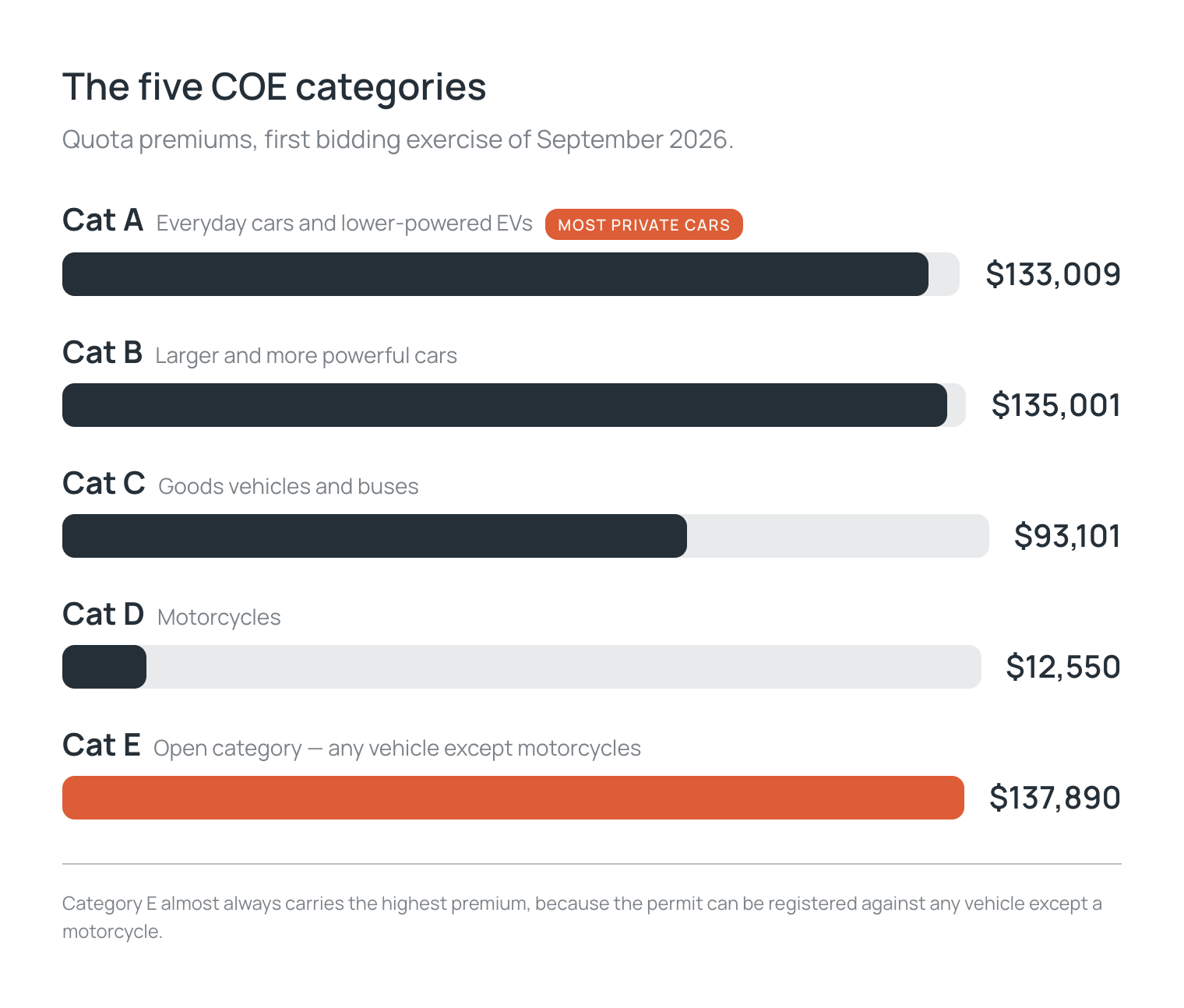
The category you bid in depends on the vehicle. Most people looking at a private car will be choosing between Category A and Category B.
Category A covers the cars most people drive day-to-day. A Toyota Corolla Hybrid, Mazda 3, or MG4 EV would fall here. The technical boundary is engine capacity up to 1,600cc with maximum power output up to 97kW (130bhp). For fully electric cars, the cutoff is 110kW (147bhp).
Because of this, Category A gets the largest quota and the most bidding activity. The September 2026 first-exercise premium closed at $133,009, a new all-time high.
If your car exceeds the Category A thresholds (above 1,600cc, above 97kW, or above 110kW for EVs), it falls into Category B. That includes most mid-range sedans, larger SUVs, and luxury or performance vehicles. A BMW 3 Series, Audi A4, or higher-spec Tesla would most likely fall under here.
Category B premiums tend to run slightly above Category A. September 2026 closed at $135,001. The buyer pool is smaller, but the pockets are deeper.
September 2026 saw this category, which primarily consists of trucks, vans, and buses, rise to $93,101.
A motorcycle COE costs a fraction of a car's. If you think riding through tropical downpours and 35-degree heat will be worth saving thousands of dollars, you’ll be pleased to know that September 2026’s Category D COE closed at $12,55.
Category E COEs can be used for any vehicle except motorcycles. Dealers, fleet operators, and parallel importers often bid here because it gives them flexibility on what they register the COE against. But because of this flexibility, it almost always carries the highest premium, with September 2026 closing at $137,890.
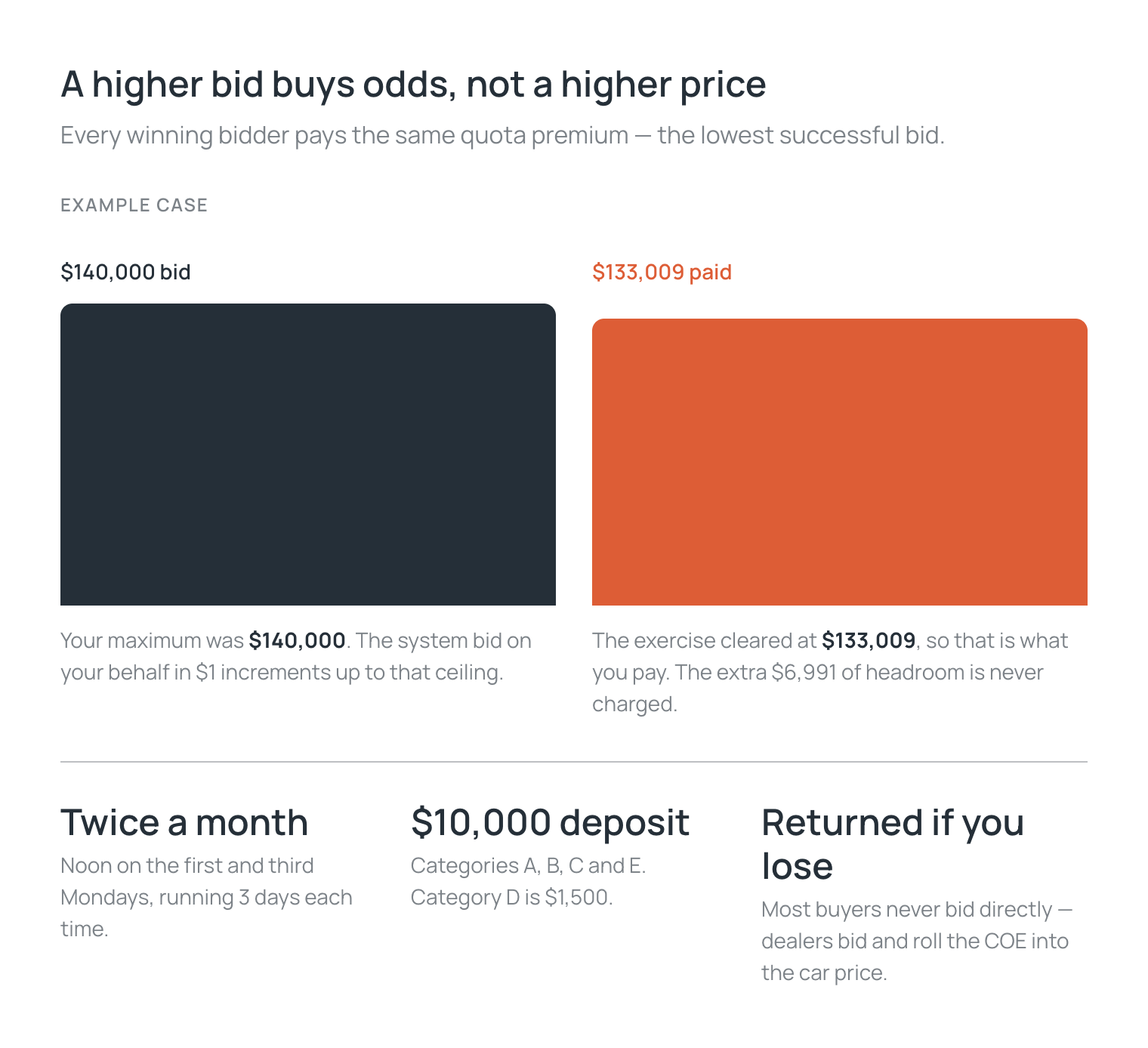
COE bidding takes place twice a month, typically kicking off at noon on the first and third Mondays and lasting 3 days each time.
It works as a sealed-bid auction. You set the maximum you're willing to pay, and the system bids on your behalf in $1 increments up to that ceiling. When the exercise closes, every winning bidder pays the same quota premium, which is the lowest successful bid.
If you set your maximum at $140,000 but the exercise clears at $133,009, you pay $133,009. A higher maximum improves your odds of getting a COE, not what you pay for it. Most buyers never deal with this directly, as car dealers typically bid on your behalf and roll the COE into the vehicle price.
Lastly, bidding requires a deposit: $10,000 for Categories A, B, C, and E, or $1,500 for Category D. Unsuccessful bidders get their deposit returned.
A COE lasts 10 years from the date of vehicle registration. When it expires, you either renew or deregister. Between registration and expiry, the car continually loses value as the COE loses valid days.
Renewal means paying the Prevailing Quota Premium (PQP), a rolling average of COE prices over the past three months. No rebidding required. You can renew for another 5 or 10 years, but take note that cars that get renewed for 5 years must be deregistered, and only cars that are renewed for 10 years can be renewed again.
Deregistration used to return a meaningful rebate through the Preferential Additional Registration Fee (PARF) scheme. However, LTA revised the PARF schedule in February 2026, halving rebates to $30,000.
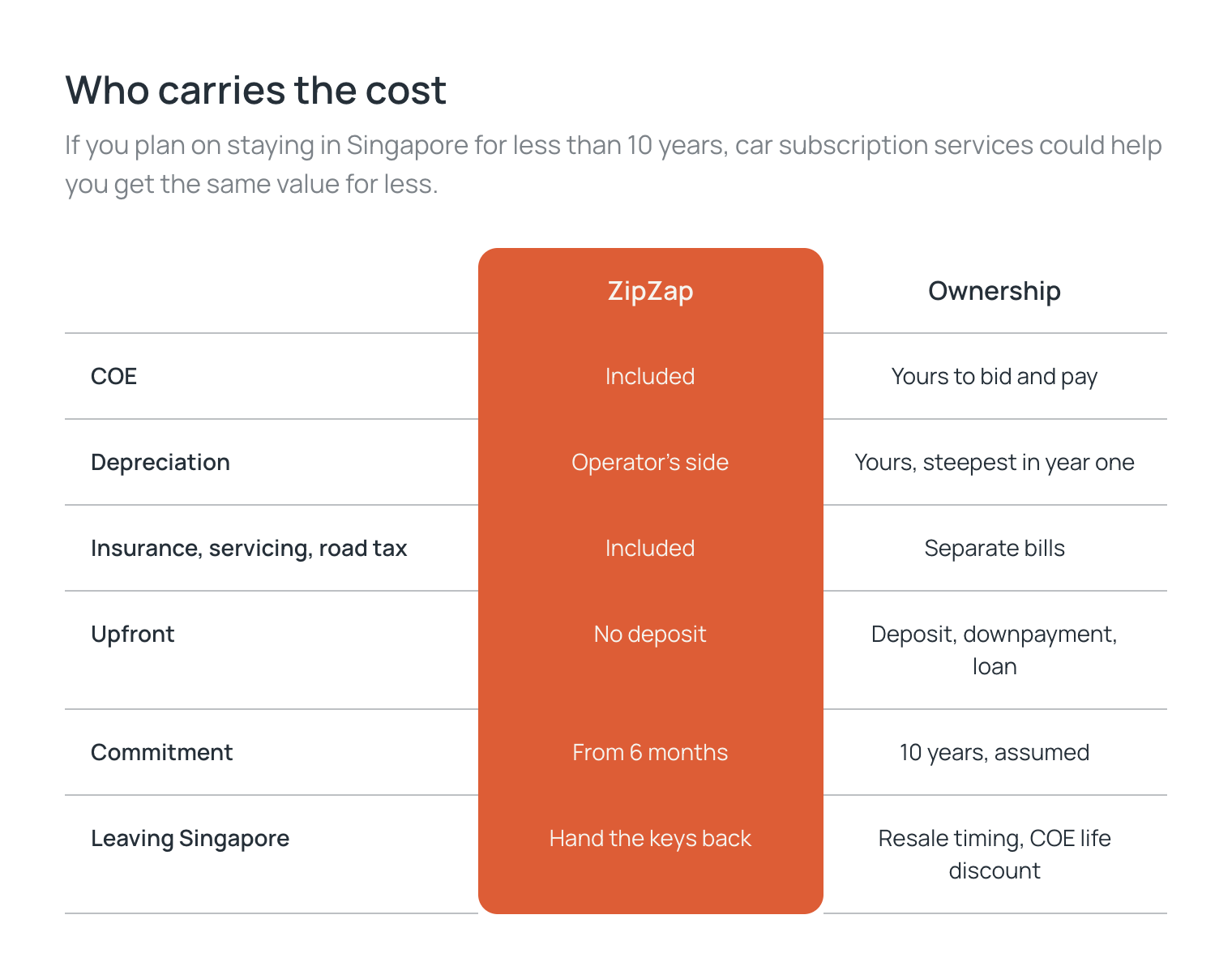
If you plan to be in Singapore for less than 10 years, paying over 6 digits for COE might turn out to be an unnecessary money sink. Options like carsharing as well as car subscription services like our very own ZipZap put the COE, depreciation, insurance, servicing, road tax, and maintenance on the operator's side. ZipZap's plans also start from six months with no deposit, so you’ll only need to pay 1 monthly fee for everything you use, and nothing extra. Stay longer, extend the plan. Leave earlier, hand the keys back. No resale timing to navigate, no COE renewal decision at the end of it.
Figures in this article reflect LTA rates as at September 2026 and are estimates for guidance.
[[testimonial]]

Michelle Kang
Project Coordinator

Olivia Cai
First-time Mum


